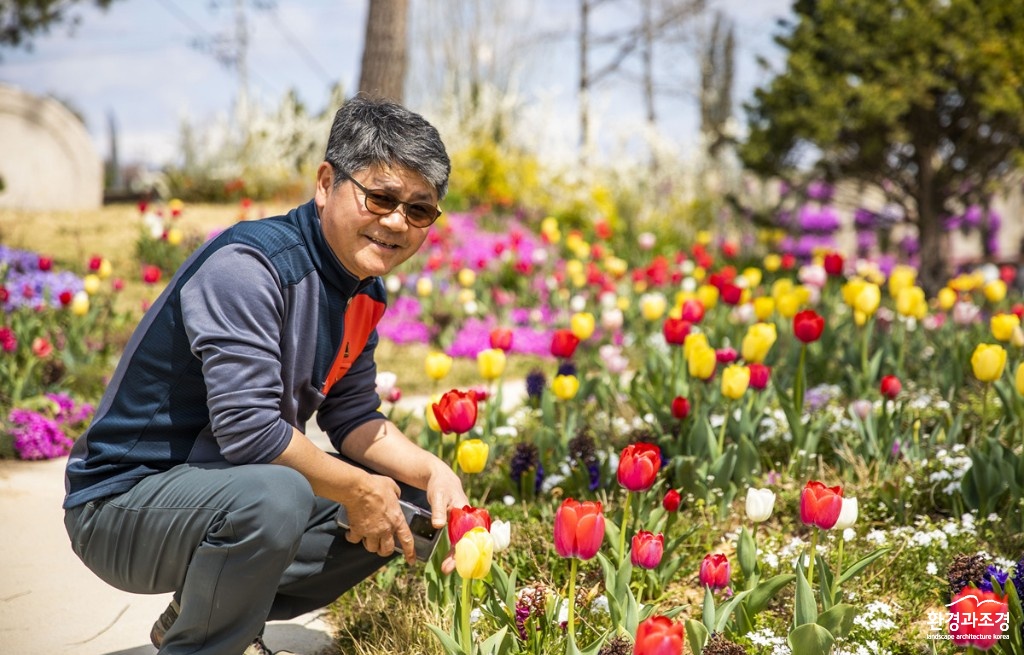
 Park Gong-young, CEO of Woori Seed Group
"Couldn't we make mixed wildflower planting easier and faster?" Woori Seed Group developed and launched "Kongkongi," a planting shovel that digs the ground.
Human desire to plant many plants can be easily found everywhere, such as pledges to plant trees, garden expos, botanical gardens, and flowerbeds that change with the seasons in amusement parks. This desire for extensive planting reaches its peak with the creation of devices that easily dig the ground, plant vegetation, and cover it with soil; as this desire gradually grows, it leads to the display of cutting-edge technologies that go beyond mere convenience and speed, appearing as if they could swallow up the vastness of nature in their entirety.
However, seeing our traditional hoe receiving renewed global attention suggests that there is a special desire for planting that cannot be satisfied by the latest technological inventions alone. This is the reason why old gardening tools are loved, and why various new devices continue to be introduced. Just what specific planting desire is 'Kongkongi,' which marks the spot for planting in each hole, fulfilling?
‘Kongkongi’s’ Simple Principle… “It Swallows and Spits Out Dirt”
"Kongkongi" is named after its resemblance to the nostalgic playground equipment "Sky Kongkong" that was popular in the 1980s; it features a long cylindrical shape with a handle. It operates on the principle that when the round cylinder is driven into the ground, a hole is created, and the soil through the hole enters the cylindrical shovel and is then discharged through the top outlet. Simply put, it "digs up, swallows, and spits out soil."
However, in order to make this technology successful, two major problems had to be solved. The first was that the soil that entered the cylinder must not flow back down to the bottom, and the second was that the soil must be properly discharged through the top outlet.
The first problem was successfully solved by narrowing the opening of the shovel to create a bottleneck, thereby preventing the soil inside the cylinder from escaping downwards. Finding the optimal angle for this was not easy, but the second problem, discharging the soil, was more difficult.
Kongkongi's discharge system is a core patented technology. When holes were dug with a simple cylinder, soil would often shoot up, scattering here and there or spilling onto the feet. This led to the idea of incorporating the 'plow,' a traditional Korean farming tool, and the 'strife' attached to it. The stipe serves to create an angle that pushes the soil backward as the plow tills the land and lifts clods of earth. Applying this principle, discharge holes were drilled into Kongkongi, and a stipe-shaped soil-turning plate was inserted and fixed in place. As a result, soil pops out and gathers in one spot every time the ground is dug. With the soil neatly discharged next to the holes, the mulching process has also become much more convenient.
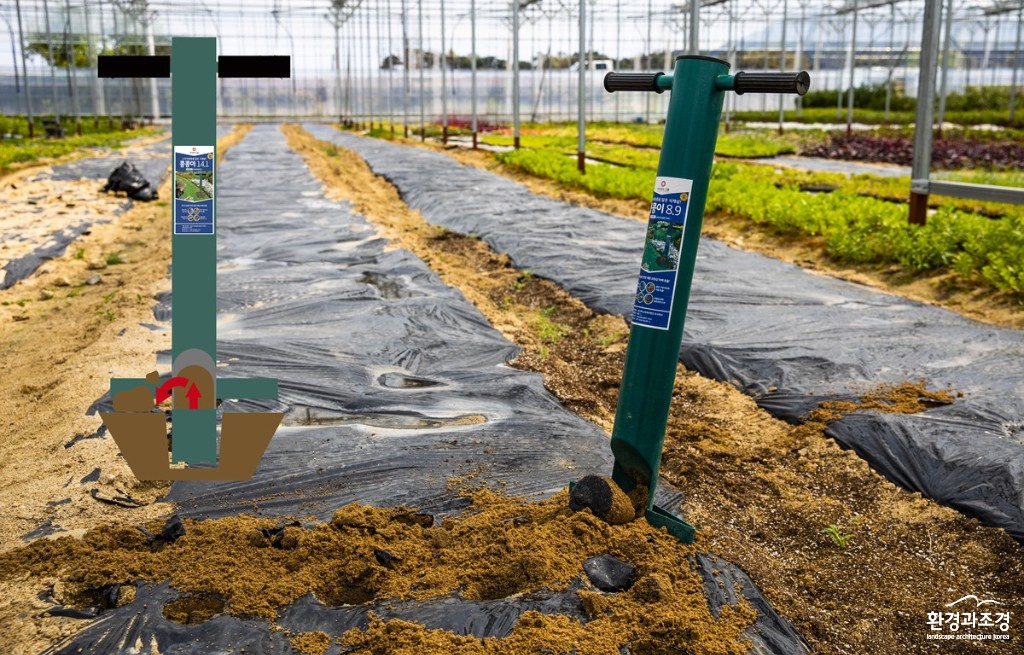
Applying patented discharge technology… ‘Innovative’ planting shovel
So, how powerful is it in the actual field? When Kongkong was applied in the field, the task of planting tulip bulbs, which usually takes several days, was completed in just one day—a surprising result.
Kongkong enables fast and uniform planting at regular intervals, demonstrating more than 10 times the efficiency of a trowel and reducing labor costs by a factor of 1/10. It allows for the creation of beautiful landscapes through the precise planting of holes made with uniform diameters, and guarantees high work efficiency as it can even penetrate and dig holes in the mulching film commonly used in Korea. Furthermore, compared to working while sitting with a hoe or trowel, it does not require excessive bending of the body, resulting in less discomfort caused by back pain, back pain, or arthritis. I felt that Kongkong, which satisfies such diverse needs, is a product that resonates particularly deeply with people who find sitting work difficult due to their protruding bellies.
But above all, Kongkong proves its worth when mixed plants are planted according to a designer's plan. Since planting holes are created simply by stepping on it, workers can draw the holes ahead and follow along, removing the pots and inserting the plants.
Small Difference ‘Kongkongi’, Drawing a Big Garden
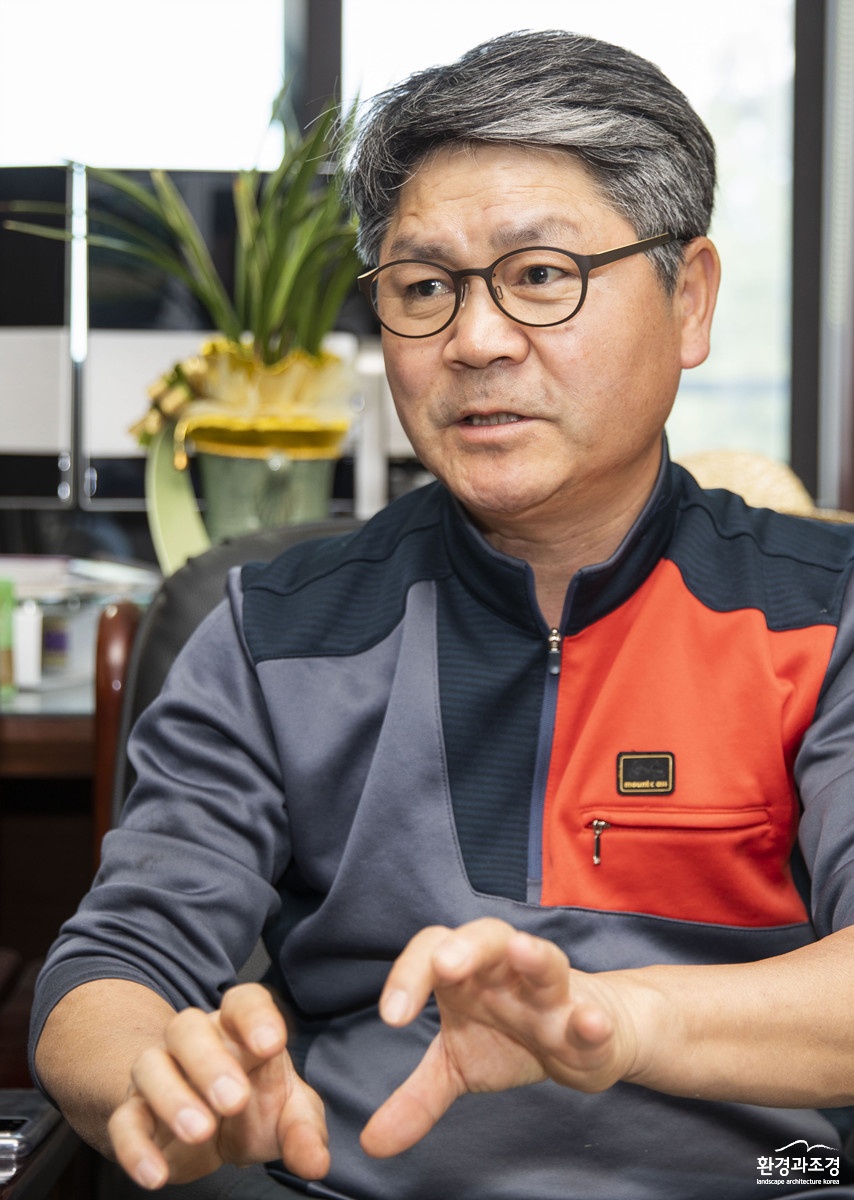
Park Gong-young, CEO of Woori Seed Group
Woori Seed Group, famous to us for its wildflowers, was established in 2000 and is celebrating its 20th anniversary this year. CEO Park Gong-young had been researching wildflowers for a long time since his college days, and immediately after founding Woori Seed Group, he garnered market attention by releasing high-quality, improved varieties. At that time, horticultural varieties accounted for less than 10% of the wildflower market, but they now make up over 90%, demonstrating the company's close ties with the development of Korean wildflowers. The 50 varieties of wildflowers developed by Woori Seed Group have been exported to Europe, generating royalties—a feat not easily achieved in Korea. However, the business has been on an upward trajectory by not limiting itself to wildflowers but undertaking diverse projects, including official residences, corporate housing, country homes, golf courses, and botanical gardens, as well as large-scale landscape festivals such as the Hampyeong Butterfly Festival and the Hanbyeol Festival. Recently, the company has been distinguishing itself in various landscaping businesses, such as theme garden projects like Ari Garden and Con Garden, as well as the "Happy Vertical Garden Haengsu" and the "Oasis" container garden. We heard from CEO Park Gong-young, who described the recently launched Kongkong as “innovative,” about the story behind the past year of development and the vision of Woori Seed.
- What is the background behind the development of Kongkong?
I devised Kongkong after working on many golf course projects. When I first started mixed planting at golf courses, I would give the elderly female workers hoes and draw diagrams for each section so they could plant accordingly. However, if I gave instructions only verbally without drawing diagrams, the work didn't go well. If I told them to plant one or two plants, they would plant three or two, or simply fail to follow instructions. Nowadays, with many foreign workers, communication is even more difficult. But with Kongkong, the work is much easier because I can directly dig holes in front of them, so they just have to plant the plants there. Furthermore, while sitting and digging with a hoe to plant prevents you from seeing the overall picture, the ability to visualize the big picture is a significant advantage.
- What are the characteristics of the Kongkong compared to other planting shovels?
Functionally, the key feature is that excavated soil is discharged into a single location rather than scattering in all directions. Since mulching is mandatory for public works planting, using Kongkong allows for easy soil covering as well as the soil collects to the side, making the process much more convenient. Furthermore, from a practical standpoint, it enables easy and rapid mixed planting. Large-scale landscape planting can be carried out accurately and quickly according to design intent, resulting in significant labor cost savings. However, due to the large overall packaging volume, logistics costs are high as the product is manufactured in China and imported; we plan to address this issue in the future and also intend to develop various devices adapted for other uses, utilizing Kongkong as the basic framework.
Woori Seed Group has celebrated its 20th anniversary. What are your future plans?
What our company pursues is to fully convey the benefits of plants to our people. We are contemplating how to deliver good energy, positive energy, and the energy to overcome environmental issues from nature to people. In this regard, we plan to create a "video magazine." We intend to structure the content in a format similar to a monthly magazine, which is received eagerly, rather than a news format where an unspecified masses gather information through searches. After all, searching is something that experts are naturally better at. The video magazine we envision targets the general public who enjoy gardening, and our goal is to present high-quality content directly to them. Rather than a pretty magazine, our aim is to create a publication that delivers clear knowledge and allows people to easily access even small pieces of information. We believe that we should not merely provide vague information like "this is how it should be" simply because it is about gardening; instead, we need to present clear information where 1+1 equals 2.