Scheduled for release after completing local adaptation.
Sales of 50,000 shares expected this year.
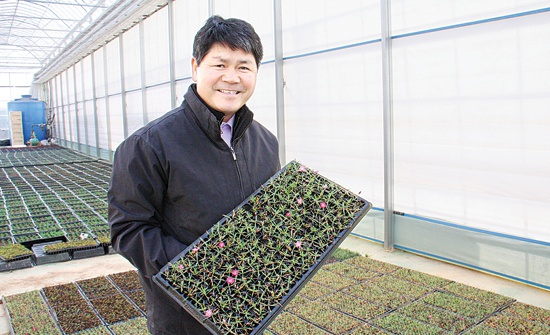 Mr. Park Gong-yeong is showing cuttings of the ‘Dianthus’ variety that he exported to Europe.
“Starting this year, I will be receiving royalties for the ‘Dianthus’ sold in Europe. It means our exports are finally bearing fruit.”
Park Gong-young (47), CEO of ‘Urikkot,’ a company in Icheon, Gyeonggi Province that produces and supplies wildflowers and landscaping plant seeds, expects that the three varieties of Dianthus he exported to Europe four years ago will be available for sale in various European countries starting this year, as they have successfully adapted to the local environment. Consequently, Mr. Park will receive a royalty of 3 cents USD (currently around 30 KRW) per plant sold in Europe. The estimated sales volume for this year is 50,000 plants.
“Although the amount is small, since this is a royalty received without exporting the flowers themselves, the added value is about 10 times that of actual exports,” he said. “As this is just the beginning, if the response from European consumers is positive, I expect the royalties to increase significantly every year.” Building on his success in exporting pinks, he plans to showcase Korean Spiraea and wildflowers such as Polygonum hydropiper and Aster tataricus at the ‘2013 IPM Essen,’ an international horticultural exhibition held in Essen, Germany, from the 22nd to the 25th of this month. He stated, “Since Spiraea is widely used as a hedge plant in Europe, there is high potential for market entry.”
He also decided to supply 100,000 plants of ‘Coreopsis,’ an improved variety of wild cosmos, to three farms in the Goyang region of Gyeonggi Province this year on a royalty basis. Regarding this, he explained, “This is to expand our domestic production base in order to export to Japan in the form of potted plants for consumption, rather than through royalty payments.” Prior to this, Mr. Park had developed new varieties of Coreopsis and exported seven varieties, named the series, to Japan via royalty payments starting in 2008. Mr. Park said, “I hope that policy-level support will be provided so that individual breeders can improve wildflower varieties and link them to exports.”